Communication Protocols
These protocols are designed for general network communication, and are widely used outside of entertainment control systems.
The communication protocols Internet Protocol (IP) and Internet Group Management Protocol (IGMP) are discussed separately.
Ethernet
IEEE 802.3
Ethernet is a collection of standardized technologies that govern network structure and data transmission. Ethernet can also be thought of as the connection between the physical devices in a network.
Ethernet divides information into frames, a unit of data dividing a longer message into formatted pieces for transmission between MAC addresses. Frames contain source and destination information, and provide error detection and data retransmission. In a network utilizing the Internet Protocol (IP) via Ethernet, the data transported by Ethernet frames is typically IP packets.
Ethernet is often used as a catch-all term for various networking hardware, including category cable, other Network Wiring, and RJ45 connectors.
Media Access Control (MAC) Address
A Media Access Control (MAC) address is a unique identifier manufacturer-assigned to any wired or wireless device that can connect to a network. Ethernet frames use MAC addressing to send and receive data.
MAC addresses are composed of six hexadecimal octets (e.g. 00:C0:16:3E:DC:FC) that can be subdivided into two components:
- Organization ID - the first three octets of the address (e.g. 00:C0:16), denoting the manufacturer or vendor. Organization IDs are standardized and maintained by the Institute of Electric and Electronics Engineers (IEEE).
- Device ID - the last three octets of the address (e.g. 3E:DC:FC), assigned by the manufacturer or vendor to denote specific hardware or products.
MAC addresses can be written in upper or lowercase, with the octets separated by colons, periods, hyphens, or not at all. These are all ways to write the same address:
| 00:c0:16:da:bb:dc | 00.C0.16.DA.BB.DC | 00-c0-16-da-bb-dc | 00C016DABBDC |
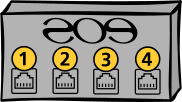
While IP Addresses can be reused, a MAC address is a generally permanent identifier of a physical wired or wireless network port and cannot be altered in the field. Each Network Interface Controller (NIC) in a multi-NIC device will have its own MAC address.
| NIC | MAC Address | NIC | MAC Address |
|---|---|---|---|
| 1 | 00:C0:16:FE:ED:1F | 3 | 00:C0:16:B1:77:F6 |
| 2 | 00:C0:16:6B:81:DA | 4 | 00:C0:16:67:AF:BB |
In Eos Family devices with built-in NICs, the MAC address for each NIC is labeled Physical Address and can be viewed in the Eos Configuration Utility (ECU) under Settings > Network > Device.
Transmission Control Protocol (TCP)
IETF RFC 761
Transmission Control Protocol (TCP) ensures reliable communication of data between devices in a network.
TCP prioritizes accuracy over delivery speed, establishing a connection with any potential receivers before transferring data. TCP sequences data to ensure it arrives in the correct order, checking for errors, and both guaranteeing and confirming delivery of the data. TCP also detects problems, rearranging or retransmitting data if necessary.
TCP is part of the Internet protocol suite, often referred to as TCP/IP, the framework of rules and protocols used for the Internet and similar networks.
Eos uses TCP in many ways, including as the preferred way to send and receive Open Sound Control (OSC) messages, aRFR and iRFR remote connections, and Augment3d tethering and file transfers.
User Datagram Protocol (UDP)
IETF RFC 768
User Datagram Protocol (UDP) allows rapid, connectionless communication of data between devices in a network.
UDP prioritizes speed and ease over reliability, and does not need or establish connections to any potential receivers before transferring data. UDP cannot arrange or sequence data, so the order packets arrive cannot be enforced. UDP cannot retrieve or retransmit lost data, and delivery is not guaranteed. UDP offers minimal error-checking which may not be enough to prevent all data issues.
UDP is also part of the Internet protocol suite.
Eos uses UDP in many ways, including as an alternative way to send and receive Open Sound Control (OSC) messages, Streaming ACN (sACN) and Art-Net control data, and serial String Commands.
Network Time Protocol (NTP)
IETF RFC 5905
Network Time Protocol (NTP) synchronizes node clocks in a network to the same global time. NTP is extremely accurate, analyzing multiple time sources using a variety of mathematical and statistical methods to avoid sync issues and latency, maintaining time within a few milliseconds of UTC.
NTP is generally the protocol used by Time Servers.
Simple Network Time Protocol (SNTP)
Simple Network Time Protocol (SNTP) is an implementation of NTP that requires fewer resources but is less accurate. SNTP is only recommended for use when time accuracy and reliability is less important, or if synced network devices are incompatible with NTP. SNTP can only receive time from NTP servers and cannot send time to other devices in a network.
Rapid Spanning Tree Protocol (RSTP)
IEEE 802.1w
Rapid Spanning Tree Protocol (RSTP) prevents network loops by managing redundant connections between switches. This protocol is offered as a feature in many managed Network Switches, determining the most optimal path to forward network traffic and rapidly adapting to changes in Network Topology to maintain the flow of data.
Ethernet Ring Protection Switching (ERPS) Protocol
ITUT-G.8032
Ethernet Ring Protection Switching (ERPS) protocol is designed to prevent loops specifically in Ring Topology networks. One of the managed Network Switches closes a segment of the ring and monitors the flow of traffic. In the event of a disconnect, the closed segment will open, healing the network and maintaining the flow of data.
The mortal enemy of Rapid Spanning Tree Protocol.