Network Wiring
Officially named category cable, network wiring is often colloquially referred to as "Ethernet cables." Different types of category cable have varying capacities and uses in entertainment control networks.
Overview
Nodes in entertainment control networks are typically connected via unshielded twisted pair (UTP) or shielded twisted pair (STP) copper wiring terminated with RJ45 connectors. This type of wiring is common and cross-compatible with most standard networking equipment. Shielding reduces electrical interference, which can be helpful if running network cables alongside power or other infrastructure cabling.
Category cable types have segment limits detailed in the table below.
Fiber
Fiber-based wiring offers many advantages over category cable, especially in terms of its increased distance rating and the speed at which it passes data. However, since switch and other node throughput still affect network speed, fiber does not necessarily make a system faster.
Fiber can also be used to differentiate connections in a Star Topology network; for example, using fiber for trunk segments between core and edge switches, with traditional category cables from edge switches to all nodes.
Connectors
Standard RJ45 category cable connectors are common and cross-compatible with most standard networking equipment. However, they can be fragile, especially in networks where devices are frequently moved and cables unplugged.
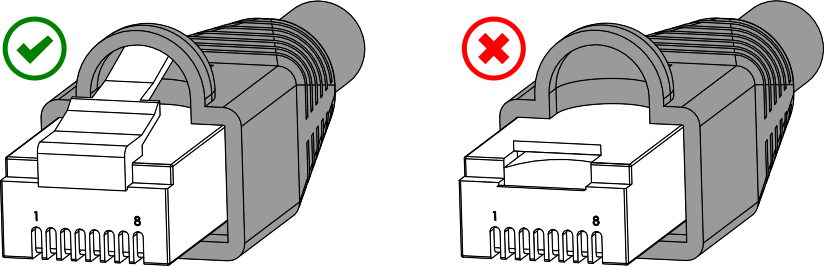
RJ45 connectors must be fully seated for reliable communication. If the plastic tab that holds the connector in place breaks, the cable must either be re-terminated with a new connector, or disposed of and replaced.
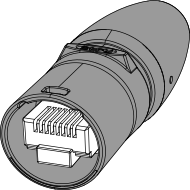
Ethercon is a rugged connector designed for the entertainment industry, combining a tabless RJ45 connector with an XLR housing that locks when inserted.
A crossover cable is a legacy option to connect two nodes directly, without the need for a switch. Crossover cables are not recommended for use in entertainment control networks.
DMX Over Cat 5
DMX over Cat 5 is an implementation of the non-network Digital Multiplex 512 (DMX) protocol that allows it to use category cable. This is distinct from Streaming ACN (sACN), which digitizes DMX data for transmission in an Internet Protocol (IP) network.
DMX to Cat 5 adapters convert between 5-pin XLR and 8-pin RJ45 connectors. They cannot transmit sACN, nor do they allow DMX devices to be plugged into a network switch. A DMX gateway must be used to translate between network infrastructure and DMX devices.
Cable Latency
For the purposes of entertainment networking, a delay of 500 ns (0.5 μs) per 100 m (328 ft) segment is sufficient to include when calculating latency for all cable types.
Detailed cable latency can be determined with the Nominal Velocity of Propagation (NVP), a proportion of the relative speed of light in a vacuum, generally represented by "c." This value is typically represented as a percentage of c; for example, NVP values of all structured wiring cables will be between 0.6c–0.9c.
| Cable Type | Max Bandwidth | Max Distance for Max Data Rate | Speed Low | Delay per 100 m | Speed High | Delay per 100 m |
|---|---|---|---|---|---|---|
| Cat 5e | TBD | 100 m (1 Gbps) | 177,000,000 m/s (0.59c) | 565 ns | 234,000,000 m/s (0.78c) | 427 ns |
| Cat 6 | TBD | 55 m (10 Gbps) 100 m (1 Gbps) |
185,000,000 m/s (0.62c) | 541 ns | 240,000,000 m/s (0.80c) | 417 ns |
| Cat 6e | TBD | TBD | TBD | TBD | TBD | TBD |
| Cat 6a | TBD | 100 m (10 Gbps) | 190,000,000 m/s (0.63c) | 526 ns | 245,000,000 m/s (0.82c) | 408 ns |
| Cat 7 | TBD | TBD | TBD | TBD | TBD | TBD |
| Cat 8 | 2000 MHz | 30 m (25–40 Gbps) | 200,000,000 m/s (0.67c) | 500 ns | 250,000,000 m/s (0.83c) | 400 ns |
| OM3 Multi-Mode Fiber | 2000 MHz/km | 300 m (10 Gbps) 100 m (40 Gbps) |
200,000,000 m/s (0.67c) | 500 ns | 210,000,000 m/s (0.70c) | 476 ns |
| OM4 Multi-Mode Fiber | 4700 MHz/km | 550 m (10 Gbps) 150 m (100 Gbps) |
200,000,000 m/s (0.67c) | 500 ns | 210,000,000 m/s (0.70c) | 476 ns |
| Single-Mode Fiber | Terahertz+ range | 10s–1000s of km (100+ Gbps) | 200,000,000 m/s (0.67c) | 500 ns | 210,000,000 m/s (0.70c) | 476 ns |
NVP values will typically be found on cable spec sheets. You can use a known NVP to determine the length of a cable, or use a known length of cable to test the NVP with cable testing equipment. This helps determine the length of a wire run, for example, in a wall. Cable length and latency limitations are crucial to ensuring reliable communication over a network.